Three Years After October 7: The Border Problem That Never Went Away
West Coast Opinion | Categories: Opinion/Politics, Military | Tags: Israel, Gaza, Hamas, October 7, security, terrorism
 This week Israelis gathered to mark three years since October 7, 2023, when Hamas-led militants killed about 1,200 people and took 251 hostage. It is the first anniversary since every hostage came home, which brings its own kind of grief.
Memorials are important. But the question I keep coming back to is a harder one: what does a country do when the threat sits right on its border, and has for twenty years? This is an opinion blog, so here is my take on the long-term security problem Israel still faces, and why a quiet border is not the same thing as a safe one.
It wasn’t one attack. It was every threat at once.
 For years Israel dealt with Gaza’s threats one at a time: rockets, tunnels, infiltrators, violent crowds at the fence. On October 7, they all arrived on the same morning. At least 4,300 rockets were launched, and roughly 6,000 militants broke through the border barrier and entered dozens of communities and military sites in the Gaza envelope.
That is what makes October 7 so important for security planners. It wasn’t a new tactic. It was the old tactics, combined and scaled up.
Rockets and mortars: the daily tax
Before October 7, rocket fire was already a fact of life in communities like Sderot. One tally counts more than 11,000 rockets fired at Israel between 2005 and 2014, and another counts 4,594 rockets and mortars during the 2014 war alone. Missile defense has saved many lives, but mortars are a different problem. They are short-range, fired from close to the border, and give residents seconds to react. Any defense against them has to stop the launch, not just the shell.
The long-term issue is not only how many rockets exist today. It is how quickly they can be rebuilt. Israeli officials said after 2014 that Hamas was already reconstructing what had been destroyed.
Tunnels: the threat you can’t see
In 2014, Israel destroyed 32 tunnels and more than 60 shafts, with exits found near kibbutz dining halls and fields beside Israeli towns. Afterward, Israel began work on a multi-billion shekel underground barrier, and Hamas leaders threatened to strike if it went up.
Yet the system had a gap. After October 7, an Israeli military spokesman acknowledged that a large tunnel near the Erez crossing had gone undetected because border defenses were built to find tunnels that entered Israel, not ones that ran beneath the border for other purposes. Tunnels also held hostages. Elkana Bohbot, freed after 738 days, described being kept 50 metres underground.
 Tunnels are cheap, hidden, and run beneath civilian areas, which is why Israel says they are so hard to eliminate. That makes them the part of Gaza’s military infrastructure most likely to be quietly rebuilt.
Suicide bombing and infiltration: the same logic, different scale
In the early 2000s, a wave of suicide bombings killed hundreds of Israeli civilians on buses, in cafes, and at markets. The response was checkpoints, intelligence work, and the West Bank security barrier. The lesson was that a single determined attacker with no warning can’t be stopped by firepower alone. It takes intelligence and physical barriers working together.
October 7 was the mass version of the same idea. Instead of one bomber, thousands of armed infiltrators. Barriers slow attackers down and buy time, but they only work if someone is watching and ready to respond. That’s the lesson Israel’s security establishment is still absorbing.
Rock throwing and the border as a pressure test
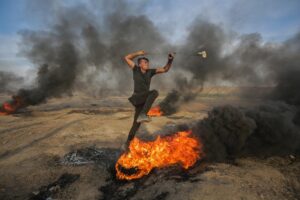
It’s easy to dismiss rock throwing as minor, but along the Gaza fence it is part of a larger pattern. In March 2018, mass protests began at the barrier, and for months they were accompanied by burning tires, rocks, and incendiary kites and balloons that set fields on fire. In August 2018, hundreds of rockets and mortar shells were fired at communities in the Gaza envelope.
Why does this matter? Crowds at a fence can test response times, probe for weak points, and provide cover for more serious attacks. They also force soldiers into an impossible choice between restraint and force. Low-level friction is how a border is tested before it is breached.
The long-term problem: quiet is not security
Three years on, a ceasefire reached nearly a year ago is in place, but Israel says it controls more than 60 per cent of Gaza, and strikes continue almost daily. Much of Gaza is in ruins. An Israeli election later this month hangs over the anniversary.
The questions that matter most are the ones nobody has fully answered. Who governs Gaza? Who disarms the groups that remain? Who stops tunnels and rocket workshops from being rebuilt, as happened after 2014? My view is that the lesson of both 2014 and 2023 is the same: periods of calm are not a strategy. Any lasting security has to deal with weapons, tunnels, and border control, not just wait for the next round.
The other side of the ledger
It would be dishonest to leave out what critics say, and many of their points deserve to be heard, even if they are often skewed in favour of a particular philosophy:
- The war that followed October 7 has killed tens of thousands of people in Gaza and left much of the territory in ruins. Critics argue that this scale of devastation, and the blockade before it, deepens grievance rather than ending the threat. But what critics miss is the fact that intrenched in the Hamas charter is their commitment to the extermination of Israel and 100% of its citizens.
- The 2018 border protests also saw many Palestinians killed by Israeli fire, and human rights groups have questioned whether the force used was proportionate. But this begs the question: What IS a proportionate response when your citizens can never relax for fear of another attack?
- Hamas has portrayed October 7 as a response to decades of occupation, land seizures, and settlement construction. Israel and its allies reject that as a justification for killing civilians, but many analysts argue a lasting solution requires a political settlement, not just military superiority. Reality check: political solutions, especially in the form of a two-state solution, have been offered multiple times and every time, they were rejected. Hamas is committed to genocide against Jewish Israelis. Period.
- Others note that barriers and tunnels are symptoms, and that without a credible alternative government for Gaza, every ceasefire is temporary. This author agrees completely. But as long as the world continues to support Hamas and vilify Israel, there will be no change.
Security and justice are not opposites. Whatever your view, the October 7 anniversary is a reminder that both sides pay a heavy price when a border becomes a permanent front line. What are your thoughts?
Sources
- ABC News (Australia): Israel marks third anniversary of October 7 attack
- Business Standard: October 7 attack to Gaza ceasefire: Three years of Israel-Hamas conflict
- Newscord: Israel Marks Third Anniversary of Hamas Oct. 7 Attacks as Gaza Remains In Ruins
- CBS News: Israel finds large tunnel near Gaza border close to major crossing
- ADL: Operation Protective Edge, July-August 2014
- Times of Israel: Israel begins work on NIS 2 billion underground Gaza barrier
- The Tower: Your Complete Guide to Hamas’ Network of Terror Tunnels
- Wikipedia: Battle of Nir Am; Gaza Envelope; List of Palestinian rocket attacks on Israel in 2016